Professional development
Whilst our team is based in Geelong, Ballarat and Melbourne, we have the capacity to deliver nationally
Author Steven Covey (7 Habits of Highly Effective People) described professional development as the act of “sharpening the saw”.
We don’t cover everything, but below is a selection of ‘saws’ we can help put an edge back on.

Leadership at Work’s roots grow deep and wide in the leadership and management (L&M) training space. Bringing contemporary adult learning principles into the belief “do what is true, not just what is new” allows us to access some of the formative and most impactful L&M methodologies available irrespective of your...
Find out moreHigh-performing teams do not happen by chance; they are built through deliberate behaviours, shared expectations and the confidence to have the conversations that matter. Our team development workshops create the space for people to step out of day-to-day delivery, strengthen role clarity and build the habits that sustain performance: trust,...
Find out moreProfessional development areas we can help sharpen
Conflict resolution
Utilising the Thomas-Kilmann Conflict Indicator (TKI) Modes as a basis for this training, we focus on the root cause of conflict and each participant’s default TKI mode. We then move to enlarging participants’ conflict resolution toolbox by building skills across all five TKI modes and discerning the more and less suitable scenarios in which to apply them.
Customer service
We design and deliver customised service excellence training programs for customer-facing teams. Led by Cate Schreck, author of The A-Z of Service Excellence, the programs build emotional intelligence, communication skills and teamwork capabilities to help staff deliver consistently professional customer experiences. Sessions are face-to-face, practical and tailored to each organisation’s values and service standards.
Emotional intelligence
Author Daniel Goleman described emotional intelligence as more definitive lever of leadership success than cognitive intelligence. He expressed that in any given field, the ‘bandwidth’ of cognitive intelligence is relatively narrow, whilst emotional intelligence is far wider. It is this quotient that then determines leadership and management effectiveness.
Utilisng Goleman’s model of EI, alongside 7 distinct EI competencies, each participant establishes a baseline of skills to develop and enhance through this training.
Time management
One of the more common, and frustrating conditions experienced across our workplaces, is a “lack of time”. Whilst most time management training focuses on better use of time, our approach is different; by definition, nobody can manage time, we can however manage ourselves and others. This paradigm provides participants with an entirely different perspective and in turn, focus.
Understanding your priorities and then having the tools to maintain the integrity of them, is paramount to ensuring you meet the remit of your position.
Collaboration, negotiation and positive influence
The term collaboration has become somewhat of a workplace rockstar over the last decade. It is also true that, for the most part, the mechanics of collaboration are misunderstood or incorrectly applied.
We unveil the true benefit and appropriate situations to apply a collaborative methodology, including within a negotiation. We present a simple, yet highly influential framework from which to apply collaborative skills, the intent being to create maximum value for all stakeholders.
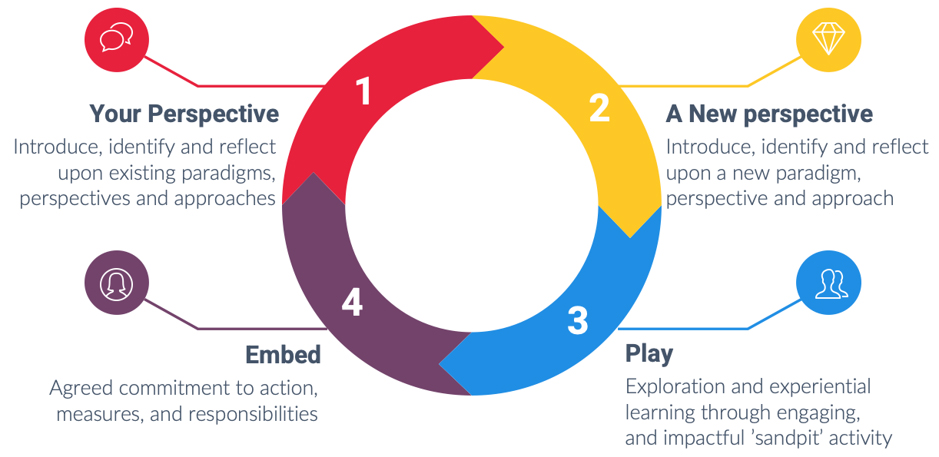
Learning methodology