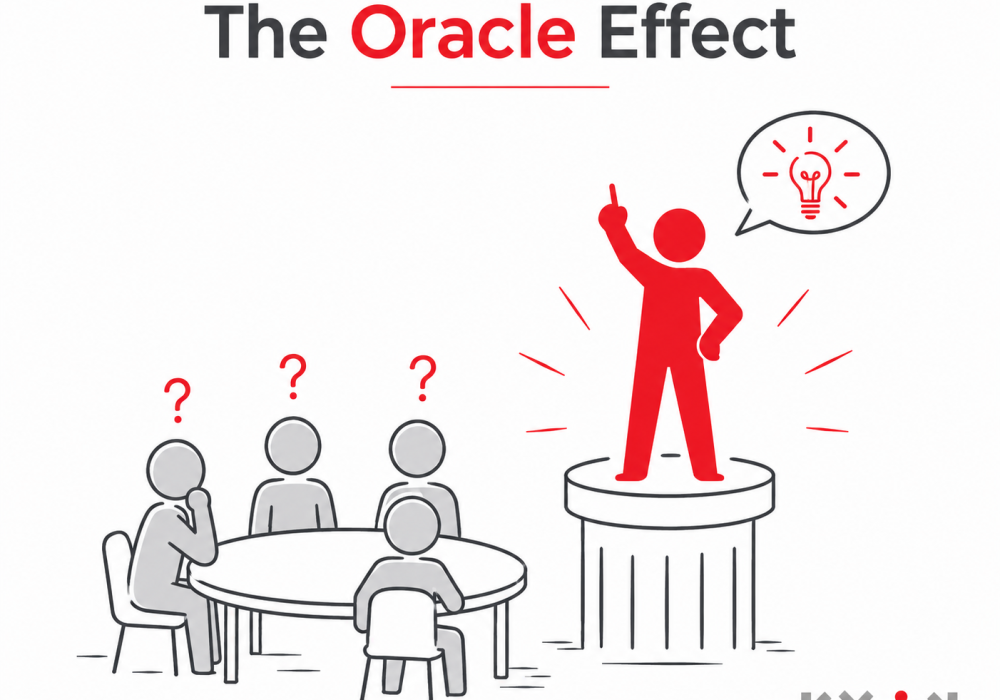
Our Leadership and Management development programs offered in Melbourne, Geelong, Ballarat and nationally as required, focus (in part) on the creation of effective communication skills. Below is an example of well-intentioned, poorly executed communication.
The Oracle Effect
Most leaders have been around the sun a few times. They have a broad ‘portfolio’ of lived experiences that can be offered in any given decision-making process. That experience is real, and it is valuable. The trouble starts when experience stops being a source of insight and becomes a substitute for listening.
We call this the Oracle Effect: the quiet belief, held by even the most capable leaders, that their seniority makes their judgement the only judgement that matters. It does not announce itself as arrogance. It arrives dressed as confidence, efficiency, even kindness — I’ve seen this before, let me save us all some time. But the effect on the people around an Oracle is the same regardless of the intention behind it. They stop bringing things forward. And an organisation that stops hearing things is not a safer organisation. It is simply a quieter one.
Being right is not the same as leading well
It would be easy to interpret the Oracle Effect as a simple case of a leader who should listen more. That is true, but it is not the whole lesson and it is certainly not the uncomfortable part.
The uncomfortable part is this: A Leader’s insight is not baseless. Years of experience is not nothing. In many cases, that experience might be exactly the context needed to guide the organisation. The position is often not the problem; execution of the message is.
This is what makes the Oracle Effect so persistent in experienced (and new) leaders, and so easy to miss in ourselves. We tend to measure our communication by whether we were correct, not by what our correctness cost the room. A leader can hold the better argument, deliver it with total sincerity, and still do real damage — not to the argument itself, but to their own credibility, and to their team’s willingness to bring the next concern forward. Being right, badly delivered, costs exactly as much as being wrong. Sometimes more, because it is so much harder to see coming.
Why it happens
The Oracle Effect rarely comes from a desire to dominate a room. More often, it comes from three things quietly reinforcing each other over a long career.
Experience compounds into certainty. Every time a leader’s judgement is proven right, it strengthens a private sense that their pattern-matching can be trusted over fresh input – even input from someone closer to the current facts than they are.
Seniority changes what silence means. When a junior team member goes quiet after being overruled, a leader often reads that silence as agreement, or at least acceptance. It is just as likely to mean the opposite: that the cost of pushing further has started to outweigh the perceived benefit.
Speed gets mistaken for strength. Leaders are often rewarded for decisiveness, for moving a meeting along, for not letting a discussion drag. Dismissing a concern quickly can feel like good leadership in the moment. Its cost only becomes visible later, and by then it rarely gets traced back to the meeting where it started.
None of these are character flaws. They are exactly the instincts that make someone effective enough to be trusted with seniority in the first place. That is precisely why the Oracle Effect is so hard for leaders to catch in themselves — the very experience that qualifies them to lead is the same experience that can quietly stop them from listening.
What it costs
The immediate cost of the Oracle Effect is rarely the dismissal of alternative ideas itself. Ideas get raised again, or found another way, or turn out not to have mattered as much as first thought. The real cost sits one layer beneath that.
It is the next person who decides not to raise a concern at all, having watched what happened to the last one who did. It is the slow drift from robust, sometimes uncomfortable collaboration towards a kind of polite, cautious distance – the very dynamic that was mistaken, in this case, for disinterest. It is a leader’s credibility, which is not damaged by being wrong, but by being seen to shut down a conversation that deserved to stay open.
None of it shows up on a dashboard. It shows up months later, in engagement figures no one can quite explain, in a project that quietly loses momentum, in good people who stop bringing their best thinking to the table – not because they have stopped caring, but because somewhere along the way, they learned it did not matter if they did.